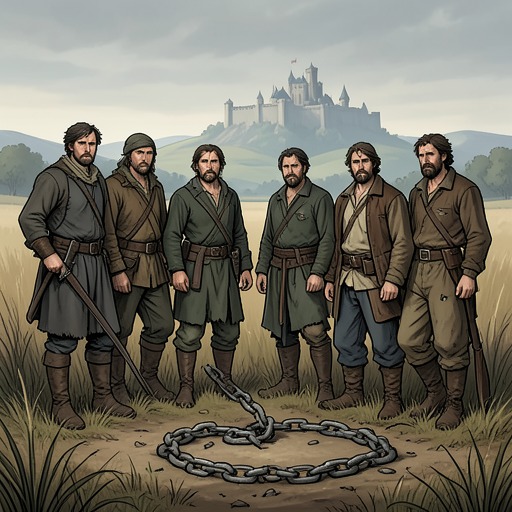
The royal pardon for the Pilgrimage of Grace
The King's CurseThe royal pardon for the Pilgrimage of Grace was the crown’s promise of clemency used to end the northern rising without a decisive battle. It persuaded thousands to disperse and seemed to bind the king to concessions on religion and government; its later failure to protect Robert Aske revealed the gulf between a public settlement and the king’s power to redefine its meaning.
Background and terms
The pardon arose amid a struggle over both religious authority and the king’s advisers. The rebels demanded the restoration of the faith of their fathers, the law, and the king’s noble counsellors, as well as the removal of Thomas Cromwell, Richard Riche, and bishops they regarded as heretical. They wanted the old religious order restored, including the abbeys. The uprising’s scale gave those demands force: reports described more than thirty thousand pilgrims, while the royal army was cold, hungry, short of money, and poorly equipped. Its commanders feared that soldiers might desert if they encountered the pilgrims’ badge.
Before the main settlement, the rebels in Lincolnshire had already been offered a pardon on condition that they return home. That offer did not resolve the wider crisis: Yorkshire was now in arms, and the northern movement had grown too powerful for a local dispersal to settle the conflict. Thomas Howard was authorized to negotiate, with instructions that included the saving of the abbeys. The pardon was therefore part of a bargain under pressure, not an isolated act of royal mercy. Its practical force depended on whether the king would honor the religious and political assurances accompanying it.
Negotiation and public settlement
At Doncaster, the pilgrims presented their demands to Thomas Howard and agreed to parley rather than fight. Their numbers and the weakness of the royal forces made open battle dangerous for the crown. The king consented to a general pardon and an agreement to restore the old ways. Thomas Howard carried the pardon north through snow and waited outside Doncaster while the Lancaster herald presented it to the assembled northerners.
Robert Aske, the movement’s leader, knelt before the pilgrims and announced that they had won a great victory. He asked them to release him from his post as captain; after they agreed, he removed the badge of the Five Wounds and promised that they would wear no badge but the king’s. The change of insignia made the settlement visible. The rebels were not simply abandoning their cause: they were trusting that the king’s pardon and promises had secured it. At the same time, the gesture returned public allegiance to the monarch and marked the movement’s formal dispersal.
The news was celebrated in London as a rescue of the country, the Church, and the king from his own course of rule. During the Christmas progress from Westminster to Greenwich, crowds welcomed the royal party on the frozen river and shouted for the king, queen, and Princess Mary Tudor. The celebration gave the settlement a public, ceremonial face, while popular support for Mary and the old faith suggested that the northern demands had an audience beyond the rebel ranks. The optimism was intense: the pardon seemed to have ended the crisis and made it possible for the Pole family’s sons to return home.
The pardon as a guarantee
The pardon’s authority rested not only on its words but also on the king’s apparent commitment to the negotiated terms. Robert Aske carried the pardon and wore the king’s scarlet satin jacket, presented as a sign of royal favor. He assured northern lords and gentlemen that there was no rebellion against the king: the pilgrims had won what they sought, and the king had given his word. This assurance mattered when reports emerged that some pardoned men had again taken up arms. Aske argued that such men did not invalidate the peace or the pardon; the agreement, he maintained, still held.
The crown’s conduct soon made that confidence precarious. Although the pilgrims had dispersed most of their force while awaiting the king’s agreement, the king ordered Lord Thomas Darcy to meet Aske under the appearance of an honorable discussion, seize him, and deliver him to Thomas Cromwell’s men. Lord Thomas Darcy’s reported response was that his coat should never bear such a stain. The episode exposed a sharp contradiction: a pardon offered to secure submission coexisted with a royal plan to capture the movement’s leader through deception.
Reversal and consequences
Aske was eventually imprisoned in the Tower of London despite holding a full royal pardon for leading the Pilgrimage of Grace. He had neither led nor encouraged later uprisings; after returning north from court, he had urged men to accept the pardon and trust the king’s word. Thomas Cromwell nevertheless framed Aske’s efforts to reassure people that the pilgrimage had achieved its aims as treason. In this interpretation, promises to restore the monasteries and hold a northern Parliament became evidence against the very leader who had helped persuade the rebels to stand down.
The pardon thus failed at the point where its promise mattered most: it did not prevent Aske’s arrest or protect him from a prosecution that recast the settlement as proof of disloyalty. The subsequent trials of northern participants broadened the consequences. Among those brought to London were churchmen and gentry, as well as Robert Aske; the narrative describes the accused as being found guilty. A pardon that had enabled the king to end a dangerous confrontation became no dependable shield against later royal punishment.
Political significance
The episode makes the pardon a measure of contested authority rather than a stable legal boundary. The rebels treated the king’s word as an obligation that secured concessions and justified disbanding; royal ministers could later portray their understanding of those concessions as treason. The badge, scarlet coat, heraldic proclamation, and assembled ranks gave the agreement public form, but spectacle could not compel the crown to honor it.
Its immediate success was real: the northern army dispersed, and the king avoided the battle its commanders feared. Yet the settlement’s reversal taught a harsher lesson. Submission and a royal pardon could be used to disarm a political movement without guaranteeing that its leaders or demands would remain protected. Aske’s imprisonment turned the promise of reconciliation into an instrument of vulnerability, sharpening the book’s contrast between the language of royal mercy and the unchecked power to punish.